

An improved CNN-Transformer network for seismic denoising with local–global feature modeling

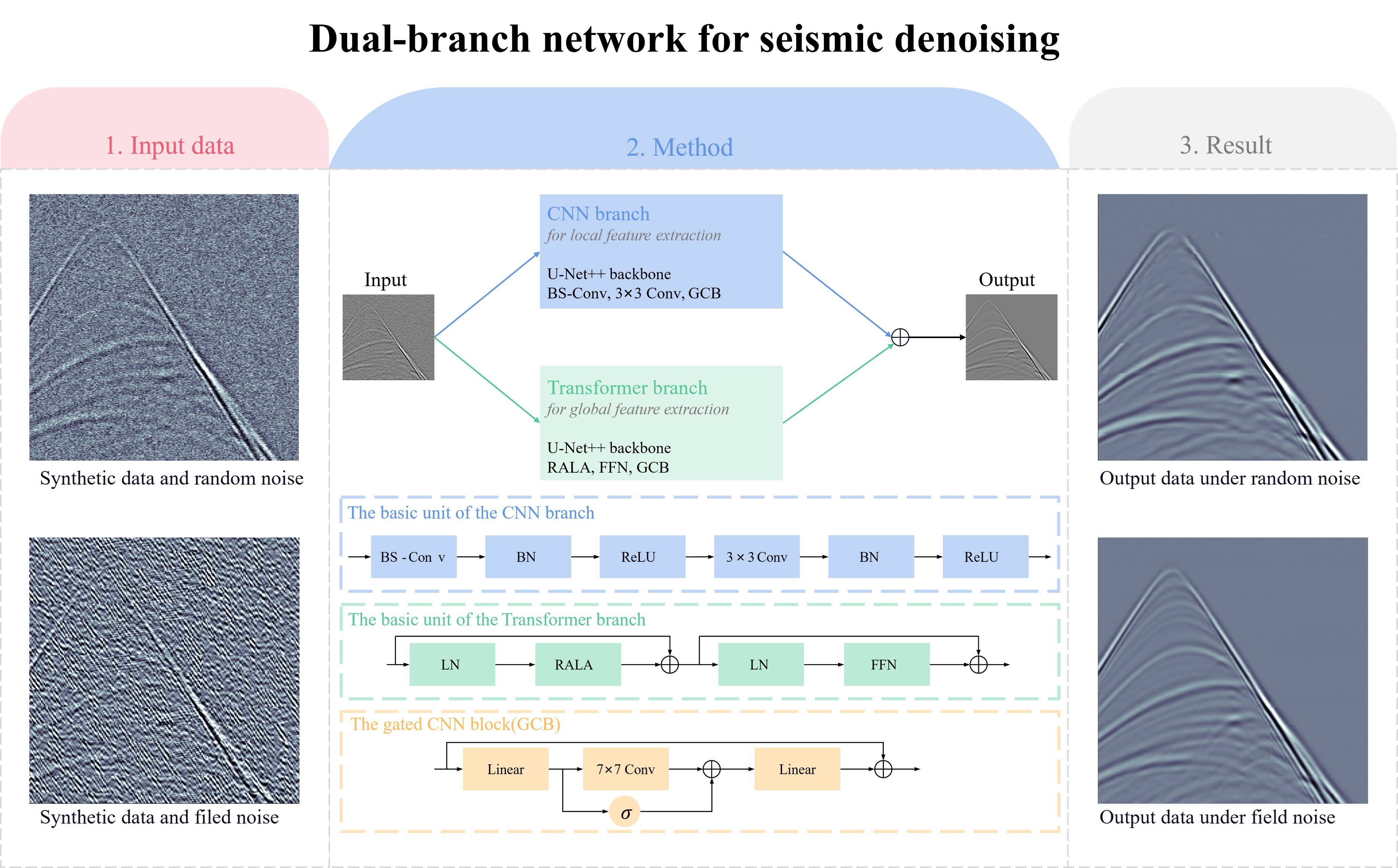
In seismic exploration, field data are always affected by noise, reducing the quality of subsequent analysis. Striking a balance between signal preservation and noise attenuation effectively is a major challenge. This study adopts a dual-branch framework with convolutional neural networks (CNN) and Transformer architecture that integrates blind-spot convolution (BS-Conv) for local detail capture, rank-augmented linear attention (RALA) for global feature extraction, and the gated CNN block (GCB) for adaptive feature selection to achieve high-fidelity signal reconstruction and noise suppression. Specifically, the CNN branch introduces BS-Conv to strengthen the local feature extraction of seismic data. The Transformer branch adopts RALA to capture long‑range dependencies, strengthening global feature extraction. Finally, each skip connection is equipped with GCB to adaptively extract relevant features. Both branches are constructed on the U-Net++ architecture and utilize its multi-scale feature-fusion capability to optimize denoising performance. The network was tested on synthetic data and field seismic data to validate the model performance. We quantitatively evaluated the denoising results using peak signal‑to‑noise ratio and structural similarity index. Comparative tests prove that this dual-branch denoising framework is superior to other methods in both noise reduction and signal fidelity. These results further confirm its effectiveness and robustness for seismic denoising on both synthetic and field data.
- Zhu W, Mousavi SM, Beroza GC. Seismic signal denoising and decomposition using deep neural networks. IEEE Trans Geosci Remote Sens. 2019;57(11):9476-9488. doi: 10.1109/TGRS.2019.2926772
- Iqbal N. DeepSeg: Deep segmental denoising neural network for seismic data. IEEE Trans Neural Netw Learn Syst. 2023;34(7):3397-3404. doi: 10.1109/TNNLS.2022.3205421
- Zhang S, Zhang L, Qin X. Seismic signal denoising using variational mode decomposition and a denoising convolutional neural network. J Seism Explor. 2025;34(2):44-59. doi: 10.36922/JSE025260030
- Cooper HW, Cook RE. Seismic data gathering. Proc IEEE. 1984;72(10):1266-1275. doi: 10.1109/PROC.1984.13016
- Wang H, Chen W, Huang W, et al. Nonstationary predictive filtering for seismic random noise suppression—a tutorial. 2021;86(3):W21-W30. doi: 10.1190/geo2020-0368.1
- Krohn C, Ronen S, Deere J, Gulunay N. Introduction to this special section—seismic noise. Leading Edge. 2008;27(2):163-165. doi: 10.1190/1.2840362
- Dong X, Li Y, Yang B. Desert low-frequency noise suppression by using adaptive DnCNNs based on the determination of high-order statistic. Geophys J Int. 2019;219(2):1281-1299. doi: 10.1093/gji/ggz363
- Canales LL. Random noise reduction. In: SEG Technical Program Expanded Abstracts. SEG; 1984:525-527. doi: 10.1190/1.1894168
- Abma R, Claerbout J. Lateral prediction for noise attenuation by t-x and f-x techniques. 1995;60(6):1887-1896. doi: 10.1190/1.1443920
- Gulunay N. Noncausal spatial prediction filtering for random noise reduction on 3-D poststack data. 2000;65(5):1641-1653. doi: 10.1190/1.1444852
- Trickett SR. F-xy eigenimage noise suppression. 2003;68(2):751-759. doi: 10.1190/1.1567245
- Liu G, Chen X. Noncausal f-x-y regularized nonstationary prediction filtering for random noise attenuation on 3D seismic data. J Appl Geophys. 2013;93:60-66. doi: 10.1016/j.jappgeo.2013.03.007
- Liu G, Liu Y, Li C, Chen X. Weighted multisteps adaptive autoregression for seismic image denoising. IEEE Geosci Remote Sens Lett. 2018;15(9):1342-1346. doi: 10.1109/LGRS.2018.2841840
- Hale D. Structure-oriented bilateral filtering of seismic images. In: SEG Technical Program Expanded Abstracts. SEG; 2011:3596-3600. doi: 10.1190/1.3627947
- Mousavi SM, Langston CA, Horton SP. Automatic microseismic denoising and onset detection using the synchrosqueezed continuous wavelet transform. 2016;81(4):V341-V355. doi: 10.1190/geo2015-0598.1
- Liu W, Cao S, Chen Y, Zu S. An effective approach to attenuate random noise based on compressive sensing and curvelet transform. J Geophys Eng. 2016;13(2):135-145. doi: 10.1088/1742-2132/13/2/135
- Qiao T, Ren J, Wang Z, et al. Effective denoising and classification of hyperspectral images using curvelet transform and singular spectrum analysis. IEEE Trans Geosci Remote Sens. 2017;55(1):119-133. doi: 10.1109/TGRS.2016.2598065
- Li J, Sacchi MD. An lp-space matching pursuit algorithm and its application to robust seismic data denoising via time-domain Radon transforms. 2021;86(3):V171-V183. doi: 10.1190/geo2020-0136.1
- Anvari R, Siahsar MAN, Gholtashi S, Kahoo AR, Mohammadi M. Seismic random noise attenuation using synchrosqueezed wavelet transform and low-rank signal matrix approximation. IEEE Trans Geosci Remote Sens. 2017;55(11):6574-6581. doi: 10.1109/TGRS.2017.2730228
- Saad OM, Chen Y, Savvaidis A, et al. Unsupervised deep learning for single-channel earthquake data denoising and its applications in event detection and fully automatic location. IEEE Trans Geosci Remote Sens. 2022;60:1-10. doi: 10.1109/TGRS.2022.3209932
- Anvari R, Kahoo AR, Mohammadi M, Khan NA, Chen Y. Seismic random noise attenuation using sparse low-rank estimation of the signal in the time–frequency domain. IEEE J Sel Top Appl Earth Obs Remote Sens. 2019;12(5):1612-1618. doi: 10.1109/JSTARS.2019.2906360
- Cadzow JA. Signal enhancement-a composite property mapping algorithm. IEEE Trans Acoust Speech Signal Process. 1988;36(1):49-62. doi: 10.1109/29.1488
- Trickett S. F-xy Cadzow noise suppression. In: SEG Technical Program Expanded Abstracts. SEG; 2008:2586-2590. doi: 10.1190/1.3063880
- Oropeza V, Sacchi M. Simultaneous seismic data denoising and reconstruction via multichannel singular spectrum analysis. 2011;76(3):V25-V32. doi: 10.1190/1.3552706
- Chen K, Sacchi MD. Robust reduced-rank filtering for erratic seismic noise attenuation. 2015;80(1):V1-V11. doi: 10.1190/geo2014-0116.1
- Dong X, Zhong T, Li Y. New suppression technology for low-frequency noise in desert region: the improved robust principal component analysis based on prediction of neural network. IEEE Trans Geosci Remote Sens. 2020;58(7):4680-4690. doi: 10.1109/TGRS.2020.2966054
- Liu X, Chen X, Li J, Chen Y. Nonlocal weighted robust principal component analysis for seismic noise attenuation. IEEE Trans Geosci Remote Sens. 2021;59(2):1745-1756. doi: 10.1109/TGRS.2020.2996686
- Bekara M, van der Baan M. Random and coherent noise attenuation by empirical mode decomposition. 2009;74(5):V89-V98. doi: 10.1190/1.3157244
- Chen Y, Ma J. Random noise attenuation by f‑x empirical‑mode decomposition predictive filtering. 2014;79(3):V81-V91. doi: 10.1190/geo2013-0080.1
- Liu N, Li F, Wang D, Gao J, Xu Z. Ground-roll separation and attenuation using curvelet-based multichannel variational mode decomposition. IEEE Trans Geosci Remote Sens. 2022;60:1-14. doi: 10.1109/TGRS.2021.3054749
- Lin H, Liu C, Wang S, Ye W. Attention mechanism-based deep denoiser for desert seismic random noise suppression. Acta Geophys. 2023;71(4):2781-2793. doi: 10.1007/s11600-023-01062-z
- Sun Y, Wei Z, Jia X, Zhu C. A deep learning-based method for enhancing isotropic reverse time migration in complex media. Acta Geophys. 2025;73(6):4003-4022. doi: 10.1007/s11600-025-01563-z
- Li D, Jiang P, Yang S, Zhang F. Multi-task deep learning for multi-parameter elastic inversion. Acta Geophys. 2025;73(4):2443-2460. doi: 10.1007/s11600-024-01500-6
- Xi H, Luo J, Liu J, et al. MSBE-UNet: A deep learning denoising method for effective seismic noise suppression. Acta Geophys. 2026;74(1):65. doi: 10.1007/s11600-026-01799-3
- Yang Z, Xue Q, Wang X, Wang T. TFDenoiser-Edge: A hybrid convolutional neural network–Transformer framework for real-time seismic denoising on edge devices in extreme environments. J Seism Explor. 2026;35(2):025010138. doi: 10.36922/JSE025010138
- Goodfellow IJ, Pouget‑Abadie J, Mirza M, et al. Generative adversarial nets. Commun ACM. 2020;63(11):139-144. doi: 10.1145/3422622
- Ronneberger O, Fischer P, Brox T. U-Net: Convolutional networks for biomedical image segmentation. In: Navab N, Hornegger J, Wells W, Frangi A, eds. Medical Image Computing and Computer-Assisted Intervention—MICCAI 2015. Lecture Notes in Computer Science; Vol 9351. New York, NY: Springer; 2015:234-241. doi: 10.1007/978-3-319-24574-4_28
- Zhang K, Zuo W, Chen Y, Meng D, Zhang L. Beyond a Gaussian denoiser: residual learning of deep CNN for image denoising. IEEE Trans Image Process. 2017;26(7):3142-3155. doi: 10.1109/TIP.2017.2662206
- Xie P, Boelle JL, Puntous H. Generative adversarial network based fast noise removal on land seismic data. In: SEG Technical Program Expanded Abstracts. SEG; 2018:2171-2175. doi: 10.1190/segam2018-2995310.1
- Zhao Y, Li Y, Dong X, Yang B. Low-frequency noise suppression method based on improved DnCNN in desert seismic data. IEEE Geosci Remote Sens Lett. 2019;16(5):811-815. doi: 10.1109/LGRS.2018.2882058
- Luo R, Li Y. Ji Yu RUnet Juan Ji Shen Jing Wang Luo De Di Zhen Zi Liao Sui Ji Zao Sheng Ya Zhi Fang Fa [Random seismic noise attenuation based on RUnet convolutional neural network]. Geophys Prospect Pet. 2020;59(1):51-59. [In Chinese] doi: 10.3969/j.issn.1000-1441.2020.01.006
- Yuan Y, Si X, Zheng Y. Ground-roll attenuation using generative adversarial networks. 2020;85(4):WA255-WA267. doi: 10.1190/geo2019-0414.1
- Wang H, Li Y, Dong X. Generative adversarial network for desert seismic data denoising. IEEE Trans Geosci Remote Sens. 2021;59(8):7062-7075. doi: 10.1109/TGRS.2020.3030692
- Yao H, Ma H, Li Y, Feng Q. DnResNeXt network for desert seismic data denoising. IEEE Geosci Remote Sens Lett. 2022;19:1-5. doi: 10.1109/LGRS.2020.3044036
- Zhong T, Cheng M, Dong X, Li Y, Wu N. Seismic random noise suppression by using deep residual U-Net. J Pet Sci Eng. 2022;209:109901. doi: 10.1016/j.petrol.2021.109901
- Dodda VC, Kuruguntla L, Mandpura AK, Elumalai K. Simultaneous seismic data denoising and reconstruction with attention‑based wavelet‑convolutional neural network. IEEE Trans Geosci Remote Sens. 2023;61:1-14. doi: 10.1109/TGRS.2023.3267037
- Wang W, Chen HL, Chang DK, Wang XY, Wang SJ, Li D. Dual-branch dense network for seismic background noise elimination. J Seism Explor. 2025;34(5):53-65. doi: 10.36922/JSE025290038
- Liu Z, Lin Y, Cao Y, et al. Swin transformer: hierarchical vision transformer using shifted windows. In: Proceedings of the 2021 IEEE/CVF International Conference on Computer Vision (ICCV). October 11-17, 2021; Online. IEEE; 2021:9992-10002. doi: 10.1109/ICCV48922.2021.00986
- Katharopoulos A, Vyas A, Pappas N, Fleuret F. Transformers are RNNs: fast autoregressive transformers with linear attention. In: III HD, Singh A, eds. Proceedings of the 37th International Conference on Machine Learning. PMLR; 2020;119:5156-5165.
- Wang H, Lin J, Li Y, et al. Self-supervised pretraining transformer for seismic data denoising. IEEE Trans Geosci Remote Sens. 2024;62:1-25. doi: 10.1109/TGRS.2024.3368282
- Li F, Liu H, Wang W, Ma J. Swin transformer for seismic denoising. IEEE Geosci Remote Sens Lett. 2024;21:1-5. doi: 10.1109/LGRS.2024.3358234
- Chen J, Chen G, Li J, et al. Efficient seismic data denoising via deep learning with improved MCA-SCUNet. IEEE Trans Geosci Remote Sens. 2024;62:1-14. doi: 10.1109/TGRS.2024.3355972
- Li J, Li JY, Li Y, Wu N, Zhang M. Dual-branch DAS denoising strategy based on SNR-aware feature fusion. Meas Sci Technol. 2025;36(8):086142. doi: 10.1088/1361-6501/adfc89
- Chen HS, Wang J, Liu BD. Dual-domain Mamba for seismic random noise suppression. J Appl Geophys. 2025;243:105951. doi: 10.1016/j.jappgeo.2025.105951
- Guo Y, He JJ, Yi SX, et al. Ji Yu DnMamba De Di Zhen Shu Ju Zao Sheng Qu Chu Fang Fa Yan Jiu Yu Ying Yong [Research on DnMamba-based seismic data denoising method and its application]. Comput Tech Geophys Geochem Explor. Published online December 1, 2025. [In Chinese] doi: 10.12474/wthtjs.20250623-0001
- Hu Y, Cheng D, Huang Z, Chen B, Lin S, Zhang S. DSCA-former: Dual-stem cross-attentive transformer for image denoising. 2026;671:132656. doi: 10.1016/j.neucom.2026.132656
- Krull A, Buchholz TO, Jug F. Noise2Void-Learning denoising from single noisy images. In: Proceedings of the IEEE/CVF Conference on Computer Vision and Pattern Recognition (CVPR). June 16-20, 2019; Long Beach, CA. IEEE; 2019:2124-2132. doi: 10.1109/CVPR.2019.00223
- Fan Q, Huang H, He R. Breaking the low-rank dilemma of linear attention. In: Proceedings of the IEEE/CVF Conference on Computer Vision and Pattern Recognition (CVPR). June 11-15, 2025; Nashville, TN. IEEE; 2025:25271-25280. doi: 10.1109/CVPR52734.2025.02353
- Yu W, Wang X. MambaOut: do we really need Mamba for vision? In: Proceedings of the IEEE/CVF Conference on Computer Vision and Pattern Recognition (CVPR). June 11-15, 2025; Nashville, TN. IEEE; 2025:4484-4496. doi: 10.1109/CVPR52734.2025.00423
- Zhou Z, Rahman Siddiquee MM, Tajbakhsh N, Liang J. Unet++: A nested U-Net architecture for medical image segmentation. In: Stoyanov D, et al., eds. Deep Learning in Medical Image Analysis and Multimodal Learning for Clinical Decision Support. Lecture Notes in Computer Science; Vol 11045. New York, NY: Springer; 2018:3-11. doi: 10.1007/978-3-030-00889-5_1
- Liang J, Cao J, Sun G, et al. SwinIR: image restoration using Swin transformer. In: Proceedings of the IEEE/CVF International Conference on Computer Vision (ICCV) Workshops. October 11-17, 2021; Online. 2021;1833-1844. doi: 10.1109/ICCVW54120.2021.00210
- Zhang K, Li Y, Liang J, et al. Practical blind image denoising via Swin-Conv-UNet and data synthesis. Mach Intell Res. 2023;20(6):822-836. doi: 10.1007/s11633-023-1466-0