

Improved low-noise waveform feature purification processing for low-signal-to-noise ratio sub-bottom profile data and its application in marine placer exploration

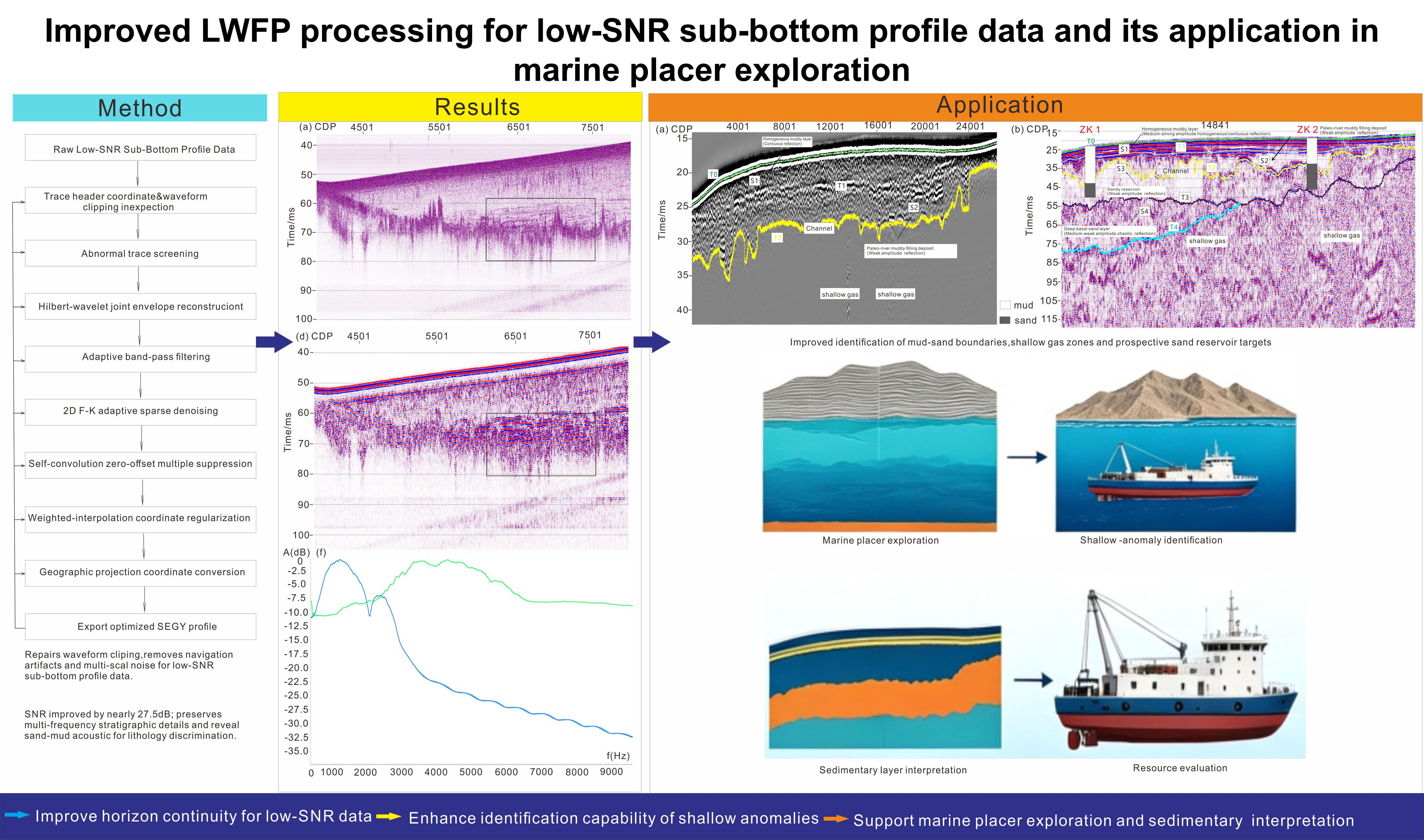
Sub-bottom profile (SBP) measurement is a widely used hydroacoustic geophysical method for continuous imaging of submarine stratigraphy. Conventional processing pipelines rely on basic filtering and envelope extraction, which fail to handle field data with waveform clipping, repeated navigation coordinates, and heavy background noise. Existing commercial seismic software and published algorithms are mainly designed for conventional seismic data and lack customized processing frameworks adapted to high-frequency SBP signals with instrument-specific distortions. This paper proposes a mathematically complete low-noise waveform feature purification (LWFP) processing pipeline tailored for low-signal-to-noise ratio SBP datasets. The integrated workflow contains four interconnected technical modules: (i) Hilbert-wavelet joint envelope reconstruction for restoring clipped waveforms; (ii) two-dimensional adaptive (F–K) sparse filtering for coherent noise attenuation; (iii) self-convolution-based zero-offset multiple suppression; and (iv) weighted-interpolation spatiotemporal coordinate regularization for navigation error correction. Comprehensive quantitative tests were conducted on the test line to validate the processing performance of the proposed method: the signal-to-noise energy gap increased by approximately 27.52 dB after the full LWFP workflow, with only minor amplitude distortion of valid stratigraphic reflections. The optimized profiles enable clear discrimination between mud and sand strata, supporting efficient marine placer delineation when jointly interpreted with single-channel seismic data. This study provides a reproducible, mathematically sound, and equipment-adaptive pipeline that meets the scientific standards of marine geophysical data processing.
- Madiligama M, Palamure PA, Zhang LK. A survey of marine seismic acoustics: water column imaging, environmental impacts, and de-bubbling. J Acoust Soc Am. 2025;158(3):2420-2447. doi: 10.1121/10.0039343
- Velegrakis AF, Ballay A, Poulos S, Radzevičius R, Bellec V, Manso F. European marine aggregates resources: origins, usage, prospecting and dredging techniques. J Coast Res. 2010;SI51:1-14. Accessed October 13, 2026. https://hdl.handle.net/1854/LU-1089415
- Yu G, Hu XC, Fang J, et al. Application of multiple geophysical exploration methods in the exploration of marine sand resources in the northern offshore waters of the South China Sea. J Mar Sci Eng. 2024;12(9):1561. doi: 3390/jmse12091561
- Wang J, Zhang KH, Lin MZ, et al. Hainandao xibu haiyu dandao dizhen yu qianceng diceng poumian lianhe jieshi [Combined interpretation of single-channel seismic and sub-bottom profiles in the western area of Hainan Island]. Mar Geol Front. 2024; 40(2):77-82. [In Chinese] doi: 10.16028/j.1009-2722.2023.034
- Kim YJ, Cheong S, Lee C, et al. Application of pseudo-3D Chirp sub-bottom profiler survey: a case study of ancient wooden shipwreck site, west coast of Korea. Explor Geophys. 2021;52(1):109-121. doi: 10.1080/08123985.2020.1776104
- Quinn R, Bull JM, Dix JK. Optimal processing of marine high-resolution seismic reflection (chirp) data. Mar Geophys Res. 1998;20(1):13-20. doi: 10.1023/A:1004349805280
- Larner K, Chambers R, Yang M, et al. Coherent noise in marine seismic data. 1983;48(7):854-886. doi: 10.1190/1.1441516
- Lee S, Won J, Jun H. Cross-equalization for time-lapse sparker seismic data. Geophys Prospect. 2024;72(9):3258-3279. doi: 10.1111/1365-2478.13600
- Duryea AP, Roberts WW, Cain CA, et al. Acoustic bubble removal to enhance SWL efficacy at high shock rate: an in vitro study. J Endourol. 2014;28(1):90-95. doi: 10.1089/end.2013.0313
- Ouergli A. Hilbert transform from wavelet analysis to extract the envelope of an atmospheric mode: examples. J Atmos Ocean Technol. 2002;19(7):1082-1086. doi: 10.1175/1520-0426(2002)019<1082:HTFWAT>2.0.CO;2
- Marino A. A wide swath parametric 3.5 kHz sub-bottom profiling system. In: Proceedings of the “Challenges of Our Changing Global Environment.” OCEANS ’95 MTS/IEEE. October 9-12, 1995; San Diego, CA. 1995;3:2016-2020. doi: 10.1109/oceans.1995.528887
- Hattingh M. A new data adaptive filtering program to remove noise from geophysical time or space-series data. Comput Geosci. 1988;14(4):467-480. doi: 10.1016/0098-3004(88)90029-5
- Nasıf A. Optimal processing of single-channel sparker marine seismic data. Acta Geophys. 2024;73(1):421-437. doi: 10.1007/s11600-024-01403-6
- Gutowski M, Malgorn J, Vardy M. 3D sub-bottom profiling-high resolution 3D imaging of shallow subsurface structures and buried objects. In: Proceedings of the OCEANS 2015–Genova. May 18-21, 2015; Genova, Italy. 2015;1-7. doi: 10.1109/OCEANS-Genova.2015.7271468
- Bull JM, Quinn R, Dix JK. Reflection Coefficient Calculation from Marine High Resolution Seismic Reflection (Chirp) Data and Application to an Archaeological Case Study. Mar Geophys Res.1998;20(1):1-11. doi: 10.1023/A:1004373106696
- Herman M, et al. Application of FK filtering for coherent noise removal in high frequency shallow marine data. IOP Conf Seri Earth Environ Sci. 2017;88(1):012010. doi: 10.1088/1755-1315/88/1/012010
- Lin T, Tao W, Xu Y, Niu W. Adaptive filtering method for low-SNR rock mass fracture microseismic signals in deep-buried tunnels considering noise Intrusion characteristics. Geosciences. 2026;16(4):143. doi: 10.3390/geosciences16040143
- Veltcheva A, Guedes Soares C. Nonlinearity of abnormal waves by the Hilbert–Huang Transform method. Ocean Eng. 2016;115:30-38. doi: 1016/j.oceaneng.2016.01.031
- Mohamed S, Mostafa R. Seabed sub–bottom sediment classification using parametric sub-bottom profiler. NRIAG J Astron Geophys. 2016;5(1):87-95. doi: 10.1016/j.nrjag.2016.01.004
- Echoes 10000 Sub-bottom Profiler Official Technical Datasheet [EB/OL]. Accessed July 17, 2026. https://www.cadden.fr/wp-content/uploads/2022/11/Sondeur-sediment-iXblue-Knudsen.pdf
- SyQwest, Inc. Bathy 2010P CHIRP Sub Bottom Profiler and Bathymetric Echo Sounder: Installation, Operation, Maintenance Manual. SyQwest, Inc; 2010. Accessed October 13, 2026. https://www.manualslib.com/manual/3051202/Syqwest-Bathy-2010pc.html
- Baradello L, Battaglia F, Vesnaver A. Fast method to transform chirp envelope data into pseudo-seismic data. Mar Geophys Res. 2021;42(2):14. doi: 10.1007/s11001-021-09436-y
- Kim SB, Park HL. Optimizing source wavelets extracted from the chirp sub-bottom profiler using an adaptive filter with machine learning. J Mar Sci Eng.2022;10(4):449. doi: 10.3390/jmse10040449
- Peng W, Tao D, Ma Q, Xie QC, Wang J. Clipped seismic record recovery analysis based on the cubic spline interpolation algorithm. J Seismol. 2024;28(3):843-857. doi: 10.1007/s10950-024-10207-6
- Liu F, Zhang Y, Yildirim T, Zhang J. Signal denoising optimization based on a Hilbert-Huang transform-triple adaptable wavelet packet transform algorithm. EPL. 2019;124(5):54002. doi: 10.1209/0295-5075/124/54002
- Abdul Latiff AH, Hermana M. Application of FK Filtering for Coherent Noise Removal in High Frequency Shallow Marine Data. IOP Conf Ser Earth Environ Sci. 2021;88(1):012010. doi: 10.1088/1755-1315/88/1/012010
- Zhou G, Song N, Jia G, et al. Adaptive adjustment for laser energy and PMT gain through self-feedback of echo data in bathymetric LiDAR. IEEE Trans Geosci Remote Sens. 2024;62:1-22. doi: 1109/TGRS.2024.3403895
- Zhou G, Jia G, Zhou X, et al. Adaptive high-speed echo data acquisition method for bathymetric LiDAR. IEEE Trans Geosci Remote Sens. 2024;62:1-17. doi: 1109/TGRS.2024.3386687
- Wei K, Zhang H, Zeng F. Multiples suppression in common-offset GPR data based on correlation-predictive deconvolution. Pure Appl Geophys. 2025;182(4):1617-1636. doi: 10.1007/s00024-025-03701-6
- Hargreaves N. Surface multiple attenuation in shallow water and the construction of primaries from multiples. SEG Tech Program Expanded Abstr. 2006;2689-2693. doi: 10.1190/1.2370080
- Li X, Shen Y, Chen W, et al. Seismic response of ice-water-covered two-layer seabed under obliquely incident P/SV-wave considering imperfect interface condition. Ocean Eng. 2025;342:122872. doi: 1016/j.oceaneng.2025.122872
- Cui X. On the lagged coherence estimation for seismic ground motions. Seismol Res Lett. 2026;97(1):295-308. doi: 10.1785/0220250111
- Kim YJ, Koo NH,Riedel M, et al. A case study on swell correction of Chirp sub-bottom profiler (SBP) data using multi-beam echo sounder (MBES) data. J Appl Geophys. 2017;145:100-110. doi: 10.1016/j.jappgeo.2017.08.001
- Hu H, Niu X, Wang W, et al. Ocean bottom seismograph relocation and time correction using the MCMC algorithm. Acta Oceanol Sin. 2025;44(10):101-111. doi: 1007/s13131-025-2540-y
- Fang K, Tan D, Zhang C, et al. Nature-based profiling of subsurface soil stiffness driven by tidal forces. Geophys Res Lett. 2025;52(21):e2025GL118702. doi: 1029/2025GL118702
- Wang Y, Zhang YZ, Zou XQ, et al. The sand ridge field of the South Yellow Sea: origin by river-sea interaction. Mar Geol. 2012;291-294:132-146. doi: 10.1016/j.margeo.2011.01.001
- Luo K, Liu G, Xue YL, et al. Predicting sand-layer distribution in offshore area of eastern Hainan island with single-channel seismic reflection data. Mar Geol Quat Geol. 2017;37(1):125-130. doi: 16562/j.cnki.0256-1492.2017.01.015
- Besio G, Blondeaux P, Vittori G. On the formation of sand waves and sand banks. J Fluid Mech. 2006;557:1-27. doi: 10.1017/S0022112006009256
- Kluesner JW, Brothers DS, Hart PE, et al. Practical approaches to maximizing the resolution of sparker seismic reflection data. Mar Geophys Res. 2019;40(3):279-301. doi: 10.1007/s11001-018-9367-2
- Li S, Zhao J, Zhang H, Qu S. Sub-bottom sediment classification using reliable instantaneous frequency calculation and relaxation time estimation. Remote Sens. 2021;13(23):4809. doi: 10.3390/rs13234809