

Thin-bed reservoir characterisation using high-resolution ocean-bottom-node seismic data, seismic waveform indication inversion, and a Gaussian mixture model: A case study from the Guantao Formation, Bohai Bay Basin, China

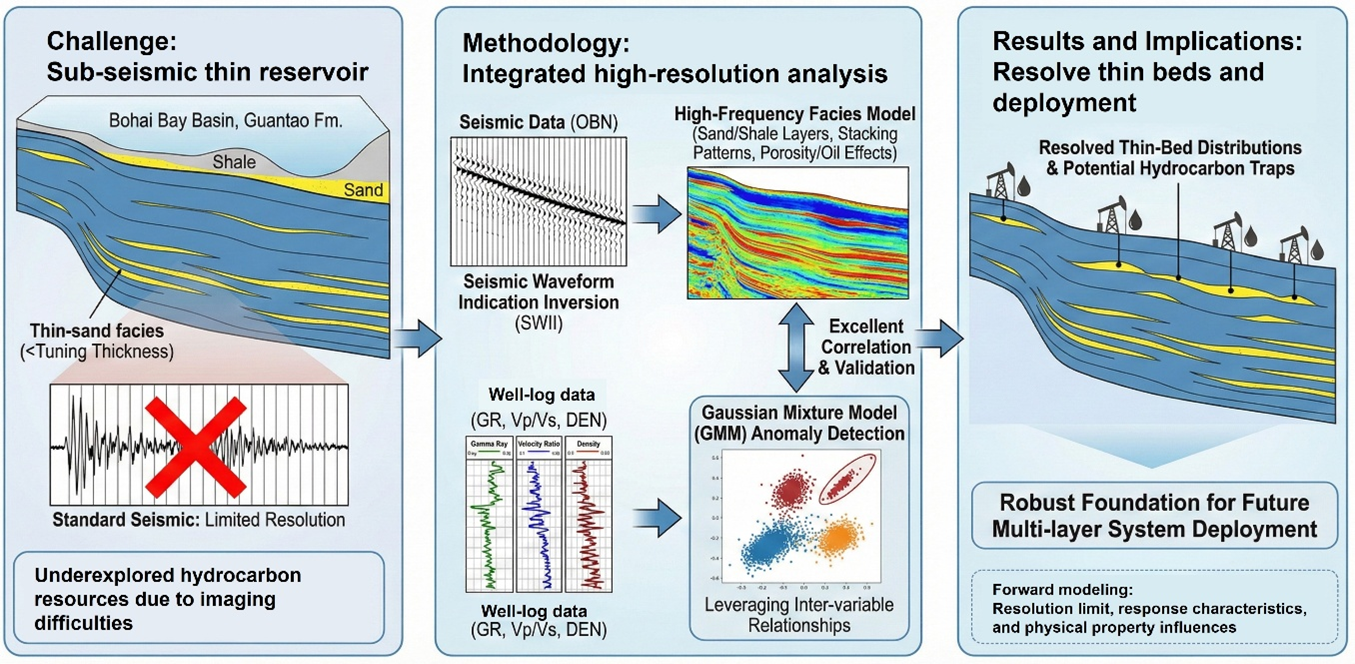
Targeting reservoirs that fall below seismic resolution remains a primary challenge in reservoir characterisation. High-resolution ocean-bottom-node seismic data are essential for imaging oil-bearing thin-sand facies, particularly in the Guantao Formation of the Bohai Bay Basin. The basin is rich in hydrocarbon resources but underexplored due to the difficulty of identifying thin-sand bodies. This study investigated thin beds below the tuning thickness to determine reservoir quality and oil–water distribution within this formation. By applying seismic waveform indication inversion (SWII) at the reservoir level, we generated a high-frequency and high-resolution facies model validated against existing geological data. Simultaneously, a Gaussian mixture model (GMM) was utilised to detect anomalies in well-log data (gamma ray, velocity ratio [Vp/Vs], and density), leveraging inter-variable relationships to enhance geological interpretability. Results demonstrated an excellent correlation between GMM anomalies and high-resolution seismic data, significantly improving prediction accuracy in complex structural regimes. SWII effectively identified thin sand-shale layers, reflecting various stacking patterns and the effects of porosity and oil-bearing properties on sand-body velocity. Forward modelling analysis revealed the seismic-resolvable thicknesses of sand bodies, the seismic response characteristics associated with various stacking patterns, and the influence of physical properties and oil-bearing characteristics on sand-body velocity, among other factors. This integrated approach effectively resolves thin-bed distributions and identifies potential hydrocarbon traps, providing a robust foundation for future multilayer system deployment in the Bohai Bay Basin.
- Darling T. Well Logging and Formation Evaluation. Gulf Professional Publishing; 2005. doi: 10.1016/B978-0-7506-7883-4.X5000-1
- Lai J, Su Y, Xiao L, et al. Application of geophysical well logs in solving geologic issues: Past, present and future prospect. Geosci Front. 2024;15(3):101779. doi: 10.1016/j.gsf.2024.101779
- Zhu J, Qu Y, Duan W, Zhang Q, Yang C. Frequency Domain Acoustic Wave Full Waveform Inversion Based on Average- Derivative Optimization. J Seism Explor. 2024;33(5):21-38.
- Pe’er U, Dy JG. Automated target detection for geophysical applications. IEEE Trans Geosci Remote Sens. 2016;55(3):1563-1572. doi: 10.1109/TGRS.2016.2627245
- Struminskiy K, Klenitskiy A, Reshytko A, et al. Well log data standardization, imputation and anomaly detection using hidden Markov models. In: Petroleum Geostatistics 2019; September 2-6, 2019; Florence, Italy. European Association of Geoscientists & Engineers; 2019:1-5. doi: 10.3997/2214-4609.201902208
- Al-Fakih A, Kaka SI, Koeshidayatullah AI. Reservoir property prediction in the North Sea using machine learning. IEEE Access. 2023;11:140148-140160. doi: 10.1109/ACCESS.2023.3336623
- Liu J, Zhu H, Liu Y, Wu H, Lan Y, Zhang X. Anomaly detection for time series using temporal convolutional networks and Gaussian mixture model. In: Journal of Physics: Conference Series. 2018 International Symposium on Power Electronics and Control Engineering (ISPECE 2018); December 28-30, 2018; Xi’an, China. IOP Publishing; 2019;1187(4):042111. doi: 10.1088/1742-6596/1187/4/042111
- Reynolds D. Gaussian mixture models. In: Li SZ, Jain AK, eds. Encyclopedia of Biometrics. Springer; 2015:827-832. doi: 10.1007/978-1-4899-7488-4_196
- Jia J, Zheng X, Wang Y, et al. The effect of artificial intelligence evolving on hyperspectral imagery with different signal-to-noise ratio, spectral and spatial resolutions. Remote Sens Environ. 2024;311:114291. doi: 10.1016/j.rse.2024.114291
- Sun M, Yasin Q, Daniel E, et al. Swin-UNETR: A transformer-based model for 3D pore network segmentation in low-permeability sedimentary rocks. Int J Coal Geol. 2026;315:104951. doi: 10.1016/j.coal.2026.104951
- Ashraf U, Zhang H, Anees A, et al. Controls on reservoir heterogeneity of a shallow-marine reservoir in Sawan Gas Field, SE Pakistan: Implications for reservoir quality prediction using acoustic impedance inversion. Water. 2020;12(11):2972. doi: 10.3390/w12112972
- Yasin Q, Ding Y, Baklouti S, Boateng CD, Du Q, Golsanami N. An integrated fracture parameter prediction and characterization method in deeply-buried carbonate reservoirs based on deep neural network. J Pet Sci Eng. 2022;208:109346. doi: 10.1016/j.petrol.2021.109346
- Jackson CA, Larsen E. Temporal constraints on basin inversion provided by 3D seismic and well data: a case study from the South Viking Graben, offshore Norway. Basin Res. 2008;20(3):397-417. doi: 10.1111/j.1365-2117.2008.00359.x
- Chetia B, Nagaraju J, Sharma SK, Kumar A. Reservoir characterization through seismic inversion: A case study. In: SEG Technical Program Expanded Abstracts 2019. 89th Society of Exploration Geophysicists International Exposition and Annual Meeting 2019; September 15-20, 2019; San Antonio, TX. SEG; 2019:3215-3219. doi: 10.1190/segam2019-3216159.1
- Ali M, Zhu P, Jiang R, et al. Data-driven lithofacies prediction in complex tight sandstone reservoirs: a supervised workflow integrating clustering and classification models. Geomech Geophys Geo-Energy Geo-Resour. 2024;10(1):70. doi: 10.1007/s40948-024-00787-5
- Zhang R, Sen MK, Phan S, Srinivasan S. Stochastic and deterministic seismic inversion methods for thin-bed resolution. J Geophys Eng. 2012;9(5):611-618. doi: 10.1088/1742-2132/9/5/611
- Ashraf U, Zhang H, Anees A, et al. Application of unconventional seismic attributes and unsupervised machine learning for the identification of fault and fracture network. Appl Sci. 2020;10(11):3864. doi: 10.3390/app10113864
- Yakovleva IP, Filippova KE, Kuznetsov VI, Keller TE. Comparison of deterministic and geostatistical inversion results-a case study for a gas-saturated reservoirs with coals. In: Proceedings of the 78th EAGE Conference and Exhibition 2016; May 30 - June 2, 2016; Online. European Association of Geoscientists & Engineers; 2016:1-5. doi: 10.3997/2214-4609.201601337
- Haas A, Dubrule O. Geostatistical inversion-a sequential method of stochastic reservoir modelling constrained by seismic data. First Break. 1994;12(11). doi: 10.3997/1365-2397.1994034
- Liu X, Li J, Chen X, et al. Stochastic inversion of facies and reservoir properties based on multi-point geostatistics. J Geophys Eng. 2018;15(6):2455-2468. doi: 10.1088/1742-2140/aac694
- Li X, Shen Y, Chen W, Feng S, Zhang Z, Hong H. Seismic response of ice-water-covered two-layer seabed under obliquely incident P/SV-wave considering imperfect interface condition. Ocean Eng. 2025;342:122872. doi: 10.1016/j.oceaneng.2025.122872
- Ullah J, Luo M, Ashraf U, et al. Evaluation of the geothermal parameters to decipher the thermal structure of the upper crust of the Longmenshan fault zone derived from borehole data. Geothermics. 2022;98:102268. doi: 10.1016/j.geothermics.2021.102268
- Gao J, Bi JJ, Zhao HS, Fu ZF. Seismic waveform inversion technology and application of thinner reservoir prediction. Prog Geophys. 2017;32(1):142-145. [In Chinese]. doi: 10.6038/pg20170119
- Ashraf U, Zhang H, Thanh HV, et al. A robust strategy of geophysical logging for predicting payable lithofacies to forecast sweet spots using digital intelligence paradigms in a heterogeneous gas field. Nat Resour Res. 2024;33(4):1741- 1762. doi: 10.1007/s11053-024-10350-4
- Cheng Z, Liang Z, Han J, et al. Application of pre-stack geostatistical inversion in prediction of thin high-quality conglomerate reservoir in Shawan Depression, Junggar Basin. Front Earth Sci. 2025;19(4):498-504. doi: 10.1007/s11707-025-1159-9
- Wang J, Li Z, Chen C, Meng C. Predicting gas content in coalbed methane reservoirs using seismic waveform indication inversion: a case study from the Upper Carboniferous Benxi Formation, eastern Ordos Basin, China. Acta Geophys. 2022;70(2):623-638. doi: 10.1007/s11600-022-00745-3
- Helgesen J, Magnus I, Prosser S, et al. Comparison of constrained sparse spike and stochastic inversion for porosity prediction at Kristin Field. Leading Edge. 2000;19(4):400- 407. doi: 10.1190/1.1438620
- Li B, Bi J, Wei S, Liu M, Han S. Application of waveform inversion technique in prediction of beach bar sandstone reservoir. In: Proceedings of the International Geophysical Conference; April 17-20, 2017; Qingdao, China. Society of Exploration Geophysicists and Chinese Petroleum Society; 2017:686-689.doi: 10.1190/IGC2017-174
- Nizarul O, Hermana M, Bashir Y, Ghosh DP. Improving thin bed identification in Sarawak Basin field using short time Fourier transform half Cepstrum (STFTHC) method. In: IOP Conference Series: Earth and Environmental Science. 3rd International Conference on Geological, Geographical, Aerospace and Earth Science 2015 (AeroEarth 2015); September 26-27, 2015; Jakarta, Indonesia. IOP Publishing; 2016;30(1):012003. doi: 10.1088/1755-1315/30/1/012003
- Babasafari AA, Bashir Y, Ghosh DP, et al. A new approach to petroelastic modeling of carbonate rocks using an extended pore-space stiffness method, with application to a carbonate reservoir in Central Luconia, Sarawak, Malaysia. Leading Edge. 2020;39(8):592a1-592a10. doi: 10.1190/tle39080592a1.1
- Fateh A, Al-Haji A, Elmasry H, Bikchandaev E. Customized workflow for proactive geosteering in thin heterogeneous carbonate reservoirs utilizing deep resistivity inversion. In: Proceedings of the SPWLA 64th Annual Logging Symposium; June 10-14, 2023; Lake Conroe, TX. Society of Petrophysicists and Well Log Analysts; 2023:D041S008R003. doi: 10.30632/SPWLA-2023-0046
- Purnomo EW, Abdul Latiff AH, Elsaadany MA. Predicting reservoir petrophysical geobodies from seismic data using enhanced extended elastic impedance inversion. Appl Sci. 2023;13(8):4755. doi: 10.3390/app13084755
- Liu H, Lin C, Zhang X, Wang H, Fu X. Sedimentological characteristics and controlling factors on fluvial styles of the Guantao Formation, Kongdian Oilfield, China. J Earth Syst Sci. 2019;128(2):37. doi: 10.1007/s12040-018-1058-5
- Wang J, Li ZG. Lacustrine Facies Sedimentary Characteristics of Guantao Formation in Zhanhua Sag. Appl Mech Mater. 2014;522-524:1337-1340. doi: 10.4028/www.scientific.net/AMM.522-524.1337
- Liu FT, Ting KM, Zhou ZH. Isolation forest. In: Giannotti F, Gunopulos D, Turini F, Zaniolo C, Ramakrishnan N, Wu X, eds. Proceedings of the 2008 Eighth IEEE International Conference on Data Mining; December 15-19, 2008; Pisa, Italy. IEEE; 2008:413-422. doi: 10.1109/ICDM.2008.17
- Xue S, Li Z, Feng G, et al. Visualization characterization of void structure evolution in broken limestone and its influence on permeability. Fuel. 2026;405:136412. doi: 10.1016/j.fuel.2025.136412